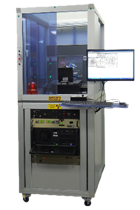
Molecular-Level In-Situ Interfacial Structure Analysis System
Molecular-Level In-Situ Interfacial Structure Analysis System
The Molecular-Level In-Situ Interfacial Structure Analysis System is based on High-Definition Vibrational Sum-Frequency Generation spectroscopy and uses nonlinear optical principles to selectively probe molecules at surfaces and interfaces, substantially
-
详细介绍
Product Advantages
Highly Interface-Selective: Selectively responds to surface and interfacial regions based on nonlinear optical principles, effectively reducing interference from bulk material signals.
Molecular-Level Structural Analysis: Provides not only interfacial vibrational information but also molecular orientation, molecular ordering, and interfacial chemical environment information.
Nanometer-Scale Probing Depth: Provides a typical probing depth of approximately 1–2 molecular layers, or around 1 nm, enabling direct investigation of the critical outermost molecular layers of materials.
In-Situ Interface Research: Supports in-situ analysis of air/solid, air/liquid, solid/liquid, and liquid/liquid interfaces under realistic experimental conditions.
Broadband and Fast Detection: Combines broadband spectral acquisition with heterodyne detection to rapidly obtain interfacial molecular vibrational information across a broad spectral region.
Quantitative Molecular Orientation Analysis: Different polarization configurations and theoretical models can be used to obtain detailed information on molecular orientation and interfacial structure.
Correlation Between Interfacial Structure and Performance: Analysis of changes in interfacial molecular structures enables researchers to investigate their relationships with material properties, reaction activity, and functional performance.
Main Features
Surface and Interface-Selective Detection: Utilizes the nonlinear optical selection rules of vibrational sum-frequency generation to provide inherent selectivity toward surface and interfacial regions.
Bulk Signal Suppression: For centrosymmetric bulk materials, the second-order nonlinear signal is theoretically zero, fundamentally reducing interference from bulk signals.
Interfacial Molecular Vibrational Information: Identifies interfacial molecules and provides information on their chemical bonds and local chemical environments through characteristic vibrational peaks.
Molecular Orientation Analysis: Enables investigation of the orientation, orientation angle, and degree of ordering of molecules at interfaces.
Heterodyne Detection: Uses heterodyne detection to obtain nonlinear optical responses from interfaces while enhancing the capability for quantitative signal analysis.
Direct Measurement of the Imaginary Nonlinear Response: Provides direct access to the imaginary component of the nonlinear response, facilitating vibrational assignment and molecular structural analysis.
Multiple Polarization Configurations: Supports multiple polarization combinations for distinguishing different molecular orientations and interfacial structures.
Broad Spectral Coverage: Covers approximately 1000–3900 cm⁻¹, supporting a wide range of interfacial molecular studies.
Spatial Scanning Analysis: Supports line scanning and an optional motorized XY scanning stage for investigating the spatial distribution of interfacial molecular structures.
Automated Operation: Optional automated measurement, self-alignment, and motorized control functions are available to simplify operation of the advanced optical system.
 Application Areas
Advanced Materials and Coatings: Investigation of molecular structures and orientations on polymer surfaces, functional coatings, adhesive interfaces, and surface-treated materials.
Semiconductors and Electronic Materials: Analysis of molecular structures, orientations, and chemical states in self-assembled monolayers, gate dielectrics, and other critical interfaces.
Energy Materials: Investigation of electrode/electrolyte interfaces and interfacial reactions in batteries, fuel cells, and solar cells.
Surface Treatment and Interface Modification: Characterization of changes in functional groups and molecular structures induced by plasma treatment, chemical modification, and other surface-processing technologies.
Biological and Biomedical Research: Investigation of molecular structures and orientations in lipid bilayers, protein adsorption, biomolecular assemblies, and other biological interfaces.
Interface Engineering and Adhesion: Analysis of molecular ordering, orientation, and chemical bonding states during the formation of interfaces between different materials.
Interfacial Reaction Studies: In-situ observation of changes in interfacial molecular structures during reactions, adsorption, and environmental changes.
Materials Failure Analysis: Comparison of interfacial molecular structures under different materials and processing conditions to investigate relationships between interface states and material performance.
Application Areas
Advanced Materials and Coatings: Investigation of molecular structures and orientations on polymer surfaces, functional coatings, adhesive interfaces, and surface-treated materials.
Semiconductors and Electronic Materials: Analysis of molecular structures, orientations, and chemical states in self-assembled monolayers, gate dielectrics, and other critical interfaces.
Energy Materials: Investigation of electrode/electrolyte interfaces and interfacial reactions in batteries, fuel cells, and solar cells.
Surface Treatment and Interface Modification: Characterization of changes in functional groups and molecular structures induced by plasma treatment, chemical modification, and other surface-processing technologies.
Biological and Biomedical Research: Investigation of molecular structures and orientations in lipid bilayers, protein adsorption, biomolecular assemblies, and other biological interfaces.
Interface Engineering and Adhesion: Analysis of molecular ordering, orientation, and chemical bonding states during the formation of interfaces between different materials.
Interfacial Reaction Studies: In-situ observation of changes in interfacial molecular structures during reactions, adsorption, and environmental changes.
Materials Failure Analysis: Comparison of interfacial molecular structures under different materials and processing conditions to investigate relationships between interface states and material performance.
-
详细参数
Technical Specifications
Product Type: High-Definition Broadband Vibrational Sum-Frequency Generation Interfacial Analysis System.
System Model: Apollo High-Definition Vibrational Sum-Frequency Generation System.
Spectral Range: Approximately 1000–3900 cm⁻¹.
Spectral Resolution: Approximately 20 cm⁻¹ standard, with approximately 10 cm⁻¹ available as an option.
Single-Acquisition Spectral Range: Approximately 80–200 cm⁻¹, depending on the spectral region.
Interfacial Probing Depth: Typically approximately 1–2 molecular layers, or around 1 nm.
Measurement Geometry: Top-side and reflection measurements.
Supported Interface Types: Air/solid, air/liquid, solid/liquid, and liquid/liquid interfaces.
Polarization Configurations: Multiple polarization combinations are supported according to the specific research requirements.
Spot Size: Approximately 300 μm.
Line-Scanning Range: Up to approximately 20 mm, with an optional motorized XY scanning stage.
Sample Size: Approximately 30 mm × 30 mm, with a maximum sample height of approximately 10 mm.
Laser System: Ultrafast pulsed laser system used as the primary excitation source.
Typical Laser Parameters: Approximately 6 W output power, approximately 250 fs pulse duration, 1035 nm central wavelength, and 10 kHz–1 MHz repetition rate.
Broadband Infrared Generation Module: Tunable broadband infrared generation module.
Optical Table Size: Approximately 3000 mm × 1500 mm.
Operating Temperature: 15–30 °C.
Power Requirements: 100 V AC / 12 A to 240 V AC / 5 A.
Rated Power: Approximately 3000 W.
-
产品特色
因用于机器人各方面应用且与大多数机器人类型兼容,AutoCal系统可以检测出机器人自身构造和工具中心点(TCP)的 突然改变或偏离,并且该系统无需人为干涉就自动地更正这些误差。
AutoCal系统-Dynalog的先进水平校准技术,Dynalog是机器人单元标定技术的世界领导者。它的主流产品DynaCal 系统,被应用于离线的机器人单元校准,并作为最精确的和技术先进的机器人校准程序为许多机器人制造商和终端使用者所接受。AutoCal 系统将已证实的DynaCal校准技术结合到一个在线的全自动系统中,该系统专为程序控制和复原而设计的,价格低廉。
-
详细介绍
AutoCal系统提供在线的机器人校准方案,旨在快速和自动地保证机械设备的工作性能。因用于机器人各方面应用且与大多数机器人类型兼容,AutoCal系统可以检测出机器人自身构造和工具中心点(TCP)的 突然改变或偏离,并且该系统无需人为干涉就自动地更正这些误差。这意味着不用猜测哪里会出错,不用浪费宝贵时间在机器人程序重复校准上,产品品质无任何损失。
AutoCal系统-Dynalog的先进水平校准技术,Dynalog是机器人单元标定技术的世界领导者。它的主流产品DynaCal 系统,被应用于离线的机器人单元校准,并作为最精确的和技术先进的机器人校准程序为许多机器人制造商和终端使用者所接受。AutoCal 系统将已证实的DynaCal校准技术结合到一个在线的全自动系统中,该系统专为程序控制和复原而设计的,价格低廉。